One of Australia’s leading pollsters and repositories of knowledge about what and how Australians are thinking gave us some very encouraging insights recently.
Kos Samaras, a director at RedBridge, whose poll results are published in major media outlets, told us that immigration is not on the minds for voters. (https://pearlsandirritations.com/post/2026/09/politicians-keep-talking-about-immigration-voters-keep-talking-about-their-bills/) Responses from more than 400 focus groups, including many in regional and rural Australia, showed that immigration was just not on the radar.
“They talked about the mortgage that seems not to get any smaller by the year, the rent that eats into 50-plus per cent of their weekly wage, the cost of food, the rising power bill, the wait to see a doctor, and the strong sense that nobody in charge wants to listen,” he wrote. “They talked about their kids not being able to leave home.
Immigration did not come up. Not as a grievance, not as an aside, not at all.”
In short, without prompting, “immigration” per se is not an issue. But economic conditions are.
This is encouraging because, politically, raising “immigration” in Australia recently has been dog whistling. It has been an appeal to racism and religious bigotry, to a white Christian Australia. And, according to Samaras, the evidence shows that Australians are not falling for it.
What is the consequence? Surely, it means, that if people’s economic position improves, they will not be beguiled by the appeal of One Nation’s harking for the white Australia of bygone days. And why would they? A tad more than half of Australians were born overseas or have at least one parent who was born overseas.
Even after the highly publicised “rallies for Australia” in the past month or so, immigration “still does not come up” in focus groups Samaras says. “Prompt it and people will offer a view, usually a measured one about numbers and housing, and then they go straight back to what is actually happening to them.”
This is very telling about the recent surge in One Nation support. It is, Samaras says, a protest vote against the major parties on economic grounds.
It means that if the concerns are addressed, the protest will cease.
But here’s the rub, rapid population growth has caused most of the things that protest voters say concern them. And we have rapid population growth because of high immigration. More precisely we have high population growth because of the rapid increase in the number of temporary visa holders in Australia – three million of them. That’s 11 per cent of the population and 16 per cent of the workforce.
How did we get to this position? Temporary visas for work and later students were introduced by the Howard Government in 1996, largely at the behest of employer groups. No numerical limit was put upon them.
If a person ticked the boxes, they were in. Employers – not the government – determined who would come here and the circumstances in which they came. The categories of workers who qualified were forever widened and the portion of workers in the casual workforce (without holiday or sick pay or job security) increased.
The Liberal-National coalition has been given an undeserved reputation for being the better economic manager just because its policies have been more pro-business.
But being good for business is not the same thing as good economic management. And the temporary-visa scheme is a prime example. Business got the immediate benefits of cheap, casualised labour while the rest of Australia paid through stresses on infrastructure and services, finding accommodation, health, education, policing, transport and so on.
Moreover, cheap labour meant that businesses did not have to bother with investment to raise productivity. If you have to pay more to fewer works, the incentive is to make those workers more productive with investment in machinery, training, and computerisation. The temporary-visa scheme was very poor, short-sighted economic policy.
With temporary student visas, universities became dependent on international students and became more like businesses than educational institutions.
The big trouble came when the inevitable happened and all these temporary visa holders wanted to stay in Australian permanently. They renewed their visas; they over-stayed; they moved jobs; they claimed asylum, and an industry of legal immigration agents grew up.
The increased population meant increased overall GDP, notionally preventing politically damaging recessions. But the obsession with GDP instead of GDP per head is poor economic management.
GDP growth is a meaningless figure which does not tell the story of people’s lives. Who cares if the total national economic output grows if the average income per person does not grow so that people rightly feel they are going backwards and feel that the economy has been mismanaged – because it has. That is why people are fed up and why fewer are rewarding the major governing parties with their vote.
Samaras points out that his focus groups do not mention immigration.
Samaras says, “Asked who they blame for rising prices and interest rates, 59 per cent name politicians and 14 per cent name immigrants.”
But the three million extra people on temporary visas have to see doctors and have to rent a place to live. Voters may not blame immigration or immigration policy directly, but, ultimately, it is the cause of the things that concern them because of the pressure rapid population growth puts on infrastructure. It does not matter whether that extra population is black, brown, white, Christian, Hindu, atheist or Muslim.
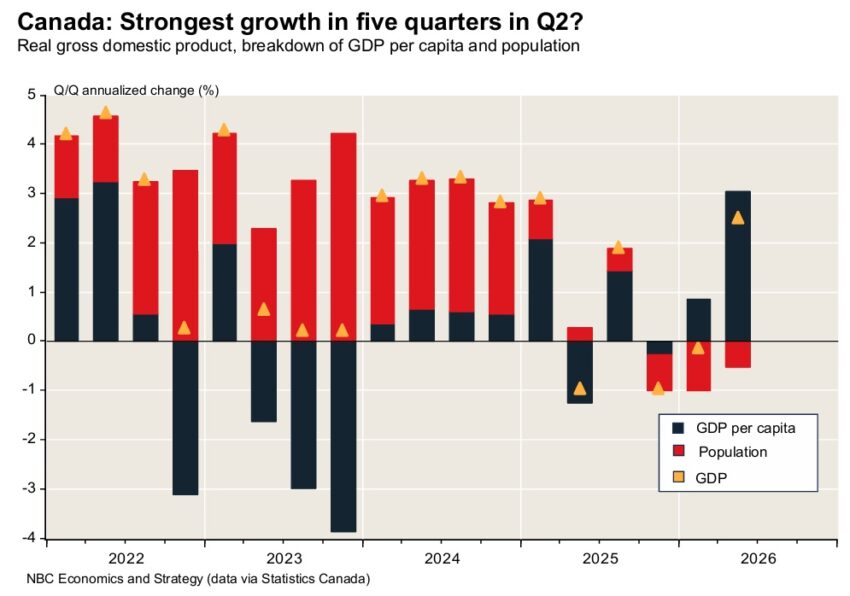
Canada is the proof that the uncontrolled blow-out in temporary visas causes the economic harm. Canada tightened temporary visas in late 2024 after the post-pandemic influx resulted in Canada having 3.1 million temporary visa holders. Since the tightening, population growth fell to zero, or even below zero in at least one quarter. National Bank of Canada figures show that as population growth slowed, GDP per head rose.
That is what Australia has got to do if we want to pull the rug out from One Nation and deprive it of a platform that has attracted a surge in support and, worse, possibly a role in Government after the next elections in Victoria and federally. Canada’s One Nation, the People’s Party of Canada, is polling at about 1 per cent of the vote.
Yes, there will be pain in agriculture, hospitality and universities if the visa system is changed, but the benefits they have had from temporary visas should be seen as a nationally costly aberration that needs correcting.
In all, though, it is good that voters they do not blame migrants for their grievances despite One Nation’s best efforts because that means they support diversity and multi-culturalism and are not racist. They rightly blame the major parties, particularly the Coalition, which caused the temporary visa mess that resulted in economic stagnation. Labor has done its best to put limits on temporary visas, but it requires legislation to remove automatic qualification, which the Coalition and Greens refuse to support.
Crispin Hull
This article first appeared in The Canberra Times and other Australian media on 6 October 2026.